Overview
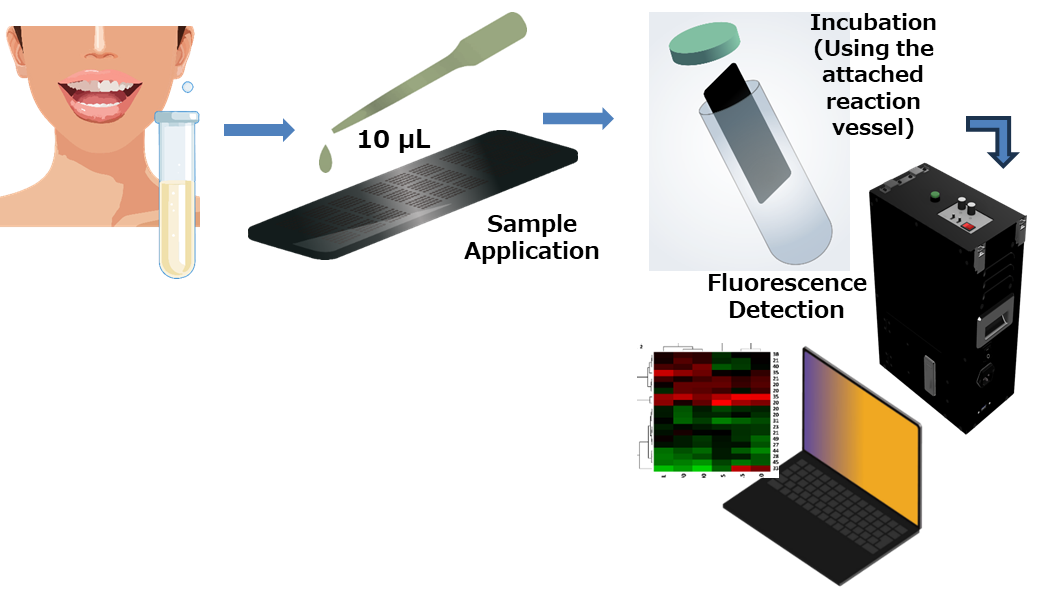
This product is the research-grade microarray, biochip, featuring 20 labeled capture peptides (found by the HiPep) focusing on periodontal disease tests. It complements conventional diagnostic methods and does not rely on the dentist’s personal experience and/or skills, providing an objective assessment of oral healthcare. Just a single drop of saliva is required. PepTenCam is a suitable detector, although measurements can also be performed by your in-house fluorescence detectors/scanners.
Features
■Objective and highly accurate results:The test incorporates 20 capturing probes specific for periodontal disease, providing objective data.
■Minimal Invasive & Rapid Mass Screening: Requiring only a single drop of saliva and just 15 to 30 min to complete. The test is ideal for efficient mass screening of large populations.
■PepTenChip® is not disposable.
■Application of proprietary PepTenChip®This product has been optimized based on our proprietary, which utilizes our unique substrate and micro-layer technology. This system enables comprehensive analysis and screening of interactions with both known and unknown proteins.
| P/N Product | Unit | Price |
| PTC-PDS-01 Oral healthcare rapid detection chip | 1 | Contact us |
| Tip storage case | 1 | Included |
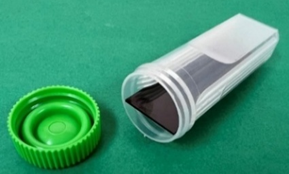
| Incubation reaction vessels | 1 | Included |
Specifications and User Manual : Oral healthcare rapid detection chip
| Immobilized Peptides | 20 types of α-Helical peptides (Seq. α-TAMRA-G-XXXX-GC-NH2) |
| Substrate | 3-block derivatized maleimide-coated amorphas carbon substrate |
| Immobilization | Immobilized via a covalent bond between the SH group of designed peptides with a polymethylene linker through a maleimide group |
| Spot diameter | ca 160 μm |
| Pitch | ca 450 μm |
| Array method | ca 0.14 pmol of peptide per spot was arrayed using a microarray spotter |
| Storage | Store the chip in the dedicated case, keep in a dark at 4°C |
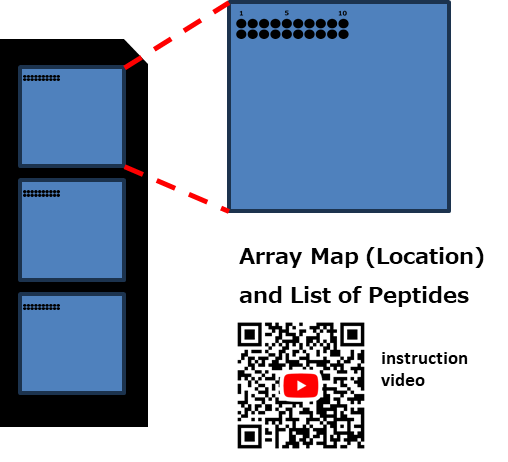
| Spot | No. | Seq. (XXXX) |
| 1 | 202 | FQQ FFK FFQ QFF KF |
| 2 | 203 | LQQ FFK FLQ QFF KF |
| 3 | 204 | LQQ LFK FLQ QLF KF |
| 4 | 205 | LQQ LLK FLQ QLL KF |
| 5 | 206 | FKK FFS FFK KFF SF |
| 6 | 213 | LSS LLK FLK KLL SF |
| 7 | 214 | FSS FFK FFS SFF KF |
| 8 | 215 | LSS FFK FLS SFF KF |
| 9 | 237 | LQQ LLR FLR RLL QF |
| 10 | 279 | LSS LLK VLK KLL SV |
| 11 | 287 | LEE LLR VLE ELL RV |
| 12 | 319 | AQQ AAK IAK KAA QI |
| 13 | 332 | AEE AIR IAE EAI RI |
| 14 | 352 | AKK FFR FAK KFF RF |
| 15 | 354 | AKK AAR FAK KAA RF |
| 16 | 380 | AKK AFS FAK KAF SF |
| 17 | 400 | AQQ FFR FAR RFF QF |
| 18 | 449 | ARR AVQ VAR RAV QV |
| 19 | 452 | AQQ AAR VAR RAA QV |
| 20 | 498 | IQQ IFR FIR RIF QF |
Operation Manual
1. Preparation and Setup:
Place the substrate on a level, clean surface free of dust and debris.
Measurement of fluorescence intensity of the substrate, I0 data using
PBS before sample application.
2. Sample Application and Incubation (for 3 blocks)
*For each block, perform steps ① and ② in the following order.
① Sample Application: Accurately dispense 10 μL of sample onto
each block.
② Cover Glass Placement: Immediately and gently place the cover
glass on top to ensure the dispensed sample spreads evenly across
the entire block.
③Processing the Remaining Blocks: Quickly repeat steps ① and ② for the remaining two blocks.
3. Incubation and Measurement
① Sealing: Immediately place the processed plate into the “Plate Reaction Vessel,” close the cap securely, and seal it.
② Incubation: Leave the plate at room temperature in a dark place for 15 to 30 minutes.
③ Fluorescence Measurement: After incubation, remove the plate and perform the measurement using a fluorescence detector, I1.
💡 Key Points for Accurate Measurement
Preventing air bubbles: When placing the cover glass, tilt it gently from the edge to avoid trapping air bubbles, which cause noise and/or signal loss during detection.
Avoid drying: Keep the time between dispensing the sample and placing the cover glass as short as possible.
Thorough Light Shielding: Important to store the chip in “dark” to prevent the fluorescent substance from fading. It is recommended that wrapping the container with aluminum foil or storing it in a light-shielding box.
Reference Related Products: Fluorescence Detection System PepTenCam, PTC-FD15 (CP06E); Other TESTING chip series s for research-use; ★ Gastric Cancer Risk (Pre-disease) Classification Chip: P/N PTC-GCM-01; ★ Cerebrospinal fluid Classification Chip (for multiple sclerosis and related diseases): P/N PTC-NDS-01 (Coming soon)
Reference
[1] Nokihara, K., Chemical Engineering, 2024, 88, 61-64.
[2] Tominaga, Y., et. al. (2018) Bioorg. Med. Chem., 26, 3210-3216.
[3] Tominaga, Y. and Nokihara , K. (2025) Anal. Methods., 17, 4590-4598.
[4] Tominaga, Y., Usui, K., Hirata, A., Ito, H. and Nokihara, K. (2018) Bioorg. Med. Chem., 26, 3210-3216, 2018.
Videos:
①Summary Video on Bio-Detection Methods Based on New Principles Now Available https://hipep.com/?page_id=3662
②PepTenChip®/PepTenCam Videos https://youtu.be/-Zli6QZVetU
③Introducing New Carbon Substrate Material https://www.youtube.com/watch?v=xcar8LTKAcU
④Manual Array Preparation Method: Researchers without an arrayer can easily create arrays. You can create arrays using your own molecules. Protocol for Reproduction and Reuse https://www.youtube.com/watch?v=bFVfJTDY4Uw