
Summary of the research paper
This paper describes construction of an objective periodontal disease diagnostic system utilizing our unique PepTenChip® system. By showcasing a clinical application of peptide microarrays, an objective approach on conventional examinations that are heavily dependent on a dentist’s subjective experience and skill.
Title: Applications of a novel bio-detection system to saliva using protein fingerprints with data processing
Yuki Tominaga, Kenji Usui, Akiyoshi Hirata, Hiro-O Ito, Kiyoshi Nokihara
Bioorg. Med. Chem., 26, 3210-3216, 2018.
DOI: https://doi.org/10.1016/j.bmc.2018.04.049
Periodontal disease refers to a wide range of oral inflammatory conditions, from gingivitis caused by bacterial infection to severe alveolar pyorrhea. Currently, most diagnostic methods—such as periodontal probing, visual inspection, and X-ray evaluation—rely on the subjectivity and clinical expertise of dentists.
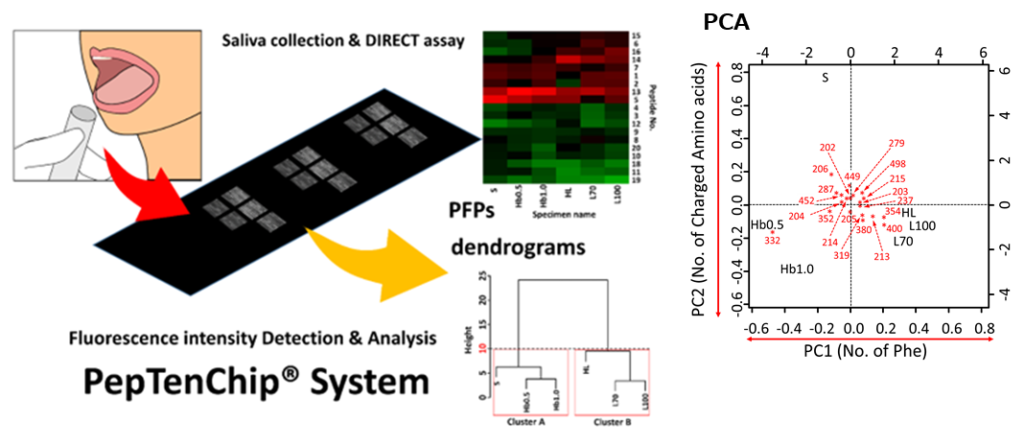
This study aimed to develop a biochip capable of objective oral-health assessment independent of the dentist’s skill, conducting experiments using disease-model saliva. Fabrication of the peptide microarray, an amorphouscarbon substrate, modified with carboxyl groups across three blocks, was derivatized with EMCA. Subsequently, peptide probes as capturing materials for periodontal disease testing were arrayed using a microarrayer. Assay by this microarray allows detection of disease-model saliva. Twenty peptide probes that exhibited significant changes in fluorescence intensity were identifies from selection of ca 500 of α-helical peptides as characteristic capturing materilas for periodontal disease. Peptide Finger Printing (PFP) analysis of the resulting fluorescence intensity data revealed specific patterns for each sample. Furthermore, cluster analyses using dendrograms demonstrated that samples could be clearly classified based on their unique characteristics. Principal Component Analysis (PCA) of the fluorescence changes also provided insights into the properties and sequences of the peptides involved in recognition. These results indicate that this chip can distinguish differences in protein composition with high precision, proving its objective utility for testing of periodontal disease. Peptide microarrays such as PepTenChip® are suitable for the comprehensive analysis of peptides interacting with specific proteins. By optimizing the selection of immobilized peptides, this system is expected to diagnostic applications to a wide variety of clinical samples.
Measurement of Saliva Samples and Data Analysis Using the PepTenChip® System
Related Videos:
Overview video on the novel bio-detection principle: https://hipep.com/?page_id=3662
PepTenChip® / PepTenCam video (English subtitles):https://www.youtube.com/watch?v=xcar8LTKAcU
Introduction to the new carbon-based substrate: https://www.youtube.com/watch?v=dksB2XGb2yA
Manual arraying method: Even researchers without an arrayer can easily create arrays using their own molecules. Protocols for regeneration and reuse are available: https://www.youtube.com/watch?v=bFVfJTDY4Uw